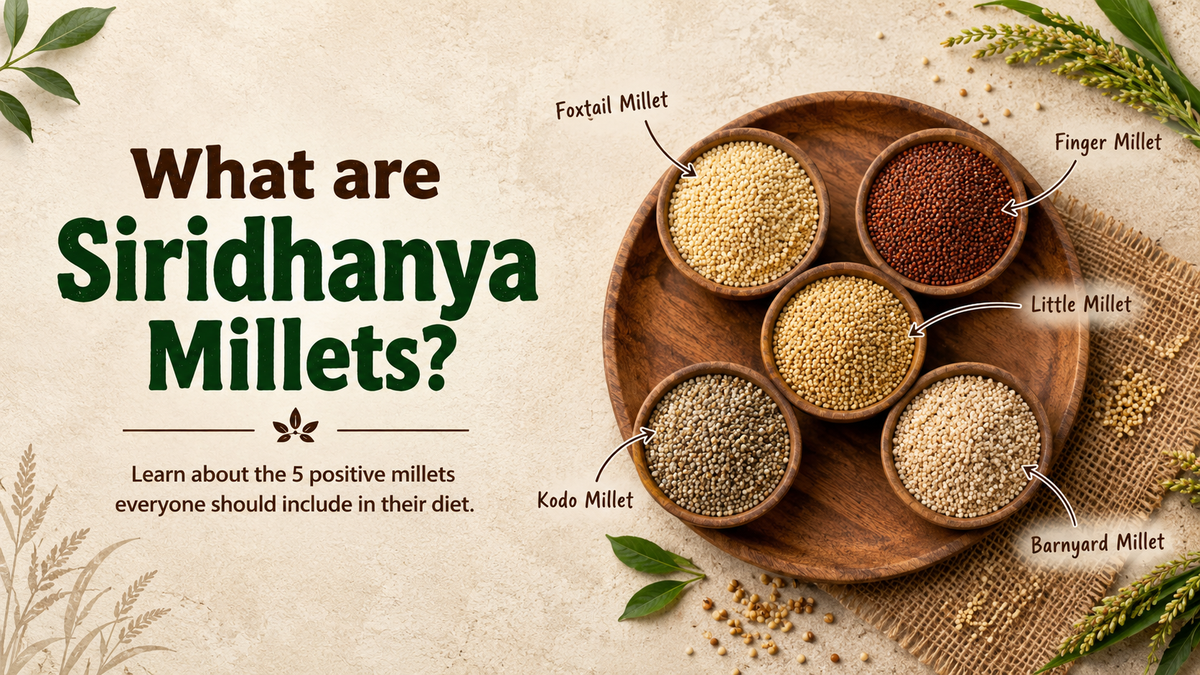

Millets have always been cultivated across India with every region cherishing its own distinct variety. You can find finger millet served as Ragi Mudde in Karnataka, pearl millet fermented into the cooling drink Rabadi in Rajasthan, and barnyard millet cooked into a savory porridge called chencha in Uttarakhand.
While these grains are rapidly gaining popularity in foreign countries as health foods, they are an absolute necessity right here at home. India faces a large diabetic population alongside severe agricultural challenges like groundwater shortages and erratic rainfall. Millets are the need of the hour to tackle these modern crises. This blog lists exactly why we must consume millets and revive our agricultural tradition today.
1. Millets consume less groundwater in comparison to wheat and rice
Producing one kilogram of paddy rice demands 8,000 liters of water. India faces a severe groundwater crisis driven by these water-intensive crops. Cultivating one kilogram of foxtail millet requires only 200 liters of water. Switching to millets reduces the strain on our depleting aquifers and offers a sustainable path forward for agriculture.
2. Growing millets supports the Sustainable Development Goals of the United Nations.

The United Nations established the Sustainable Development Goals to create a better and more sustainable future for everyone. Cultivating and eating millets supports several of these global targets. Millets contribute to SDG 2 for Zero Hunger because they thrive in harsh conditions and provide food security. They support SDG 3 for Good Health and Well-Being by offering immense nutritional value. Their low water and input requirements align with SDG 12 for Responsible Consumption and Production and SDG 13 for Climate Action.
3. Millets are ancient Indian crops tracing their roots to the Indus Valley Civilization
Archaeological excavations in the Indus Valley Civilization revealed remnants of millet grains. This discovery proves that millets were a foundational crop in India between 3300 and 1300 BC. This means these grains have been native to our lands for over 3,000 years. Their appeal even reached royalty. Mughal Emperor Jahangir used to love eating pearl millet and pea khichdi called laziza so much that he ordered it served to him routinely on days of abstinence.
Source Citation: Ankita, Seth, U. Millets in India: exploring historical significance, cultural heritage and ethnic foods. J. Ethn. Food 12, 2 (2025). https://doi.org/10.1186/s42779-024-00262-2
4. A single digit carbohydrate to fiber ratio makes positive millets ideal for diabetic diets
Nutritional science shows that a lower carbohydrate to fiber ratio helps your body digest carbs at a measured pace. This prevents sudden spikes in blood sugar. White rice has a ratio of roughly 60 because commercial milling strips away the native fiber. Unpolished millets like foxtail and barnyard retain their bran and offer a single digit ratio of 6 to 8. This dense fiber content gives millets a low glycemic index. Eating them is associated with the prevention of diabetes. Swapping refined grains for millets is a simple and proven way to manage your blood sugar levels.
|
Grain Type |
Carbohydrates (per 100g) |
Dietary Fiber (per 100g) |
Carb-to-Fiber Ratio |
Blood Sugar Impact |
|
Refined White Rice |
~80g |
~1.3g |
~60 |
Rapid Spike |
|
Brown Rice |
~77g |
~3.5g |
~22 |
Moderate Release |
|
Foxtail Millet |
~60g |
~8.0g |
~7.5 |
Slow, Measured Release (Low GI) |
|
Barnyard Millet |
~65g |
~10.0g |
~6.5 |
Slow, Measured Release (Low GI) |
5. Different positive millets function as internal cleansers for specific body organs
Dr. Khader Vali discovered that specific positive millets act as targeted internal cleansers. Their unique fiber structure helps flush out toxins from different parts of the human body. Barnyard millet detoxifies the liver and kidneys. Little millet cleanses the lymphatic system and reproductive organs. Foxtail millet clears the lungs and supports the nervous system. Kodo millet works to purify the blood and bone marrow.
6. Millets are rich in fibre and provide sustained energy without causing rapid blood sugar spikes
True millets weave dietary fiber from the core of the kernel all the way to the outer layer. Modern farming and processing strip this vital fiber away from wheat and rice, leaving only simple starch. Unpolished millets retain this deep fiber structure. This complex fiber provides sustained energy to the body without triggering rapid blood sugar spikes. Finding genuine unpolished grains in the supermarket can be difficult. That is exactly why we started mymillets. You can buy unpolished millets directly from us to ensure you get all the native fiber your body needs.
7. All Siridhanya millets offer a gluten free alternative for people with celiac disease
The Glycemic Index measures how quickly food raises blood sugar levels. High GI foods like white rice and refined wheat can increase the risk of diabetes and heart issues. Millets possess a low Glycemic Index. Beyond blood sugar control, all positive Siridhanya millets like foxtail, little, kodo, barnyard, and browntop are gluten free. This makes them a safe dietary staple for individuals suffering from celiac disease or gluten sensitivity.
8. High magnesium and folic acid levels in millets support female reproductive health
The Wildlife Institute of India publication confirms that millets are packed with crucial minerals for women's health. The high magnesium content found in millets helps regulate the menstrual cycle and reduces menstrual cramps. Researchers Ankita and Seth point out that small millets are rich in folic acid. This specific nutrient makes them beneficial for pregnant women and for curing anemia in women.
Source Citations: Nautiyal, J. P., et al. (2023). The Millets of India. Wildlife Institute of India, EIACP Centre. ISSN: 0972-088X
9. C4 plant genetics allow millets to survive extreme heat and poor soils
The Wildlife Institute of India study categorizes millets as C4 plants. This means they possess a more efficient photosynthetic pathway compared to standard C3 plants like wheat and rice. This genetic advantage allows millets to thrive in extreme heat and with little rainfall. They grow well on marginal and degraded lands with low soil fertility. This trait is great for the environment because it reduces the need for synthetic fertilizers and intensive irrigation.
Source Citation: Nautiyal, J. P., et al. (2023). The Millets of India. Wildlife Institute of India, EIACP Centre. ISSN: 0972-088X
10. Dual purpose millet crops provide food for humans and livestock fodder to protect farmers
Millets serve a dual purpose in agriculture. Crops like sorghum and pearl millet yield nutritious grain for human consumption while their leftover stalks provide valuable fodder for livestock. They also serve as a natural food source for local bird populations. Planting millets means you contribute to the local ecosystem and support the native ecological cycle. This efficiency protects farmers from economic shocks by maximizing the utility of every harvest.
11. Millet cultivation promotes regenerative jungle farming practices that heal barren landscapes

Dr. Khader Vali champions a regenerative system called Kadu Krishi or Jungle Farming. He concluded that modern chemical farming destroys soil integrity. Under Jungle Farming, farmers dedicate twenty percent of their land to grow a natural forest. This forest attracts diverse bird species. The birds drop seeds and guano across the fields. This natural bird dropping fertilization heals barren landscapes and maintains a perfect ecological balance without relying on artificial chemicals.
12. Local processing tools like the Buchchi method empower rural women and decentralize the village economy
Almost every state in India grows its own unique variety of millet. This diversity created a decentralized village economy where local communities controlled their own food supply. British colonizers disrupted this by pushing commercial export crops and framing millets as lower class food. Processing small millets was a physical burden for women. Experts developed the Buchchi method to solve this. This simple technique allows rural women to easily dehusk small millets using a standard kitchen mixer, empowering them to process grain locally and reclaim control of the rural economy.
13. Traditional fermentation unlocks hidden vitamins and neutralizes anti nutrients in raw millets
Raw millets contain anti nutrients like phytic acid and tannins. Traditional fermentation processes break down these compounds and increase the bioavailability of iron and B vitamins. Ethnic communities in the Himalayas master this technique by brewing medicinal beers like Tongba, Sura, and Madua apong from finger millets. Due to the cold climate, these fermented drinks are consumed as pre digested foods that offer anti inflammatory benefits rather than just alcoholic beverages.
Source Citation: Ankita & Seth. (2025). Millets in India: exploring historical significance, cultural heritage and ethnic foods. Journal of Ethnic Foods, 12(2).
https://doi.org/10.1186/s42779-024-00262-2
14. Iron rich millets fight hidden hunger and combat childhood malnutrition
Many children suffer from hidden hunger and micronutrient deficiencies. Millets are packed with essential minerals. Pearl millet, finger millet, and barnyard millet contain high levels of dietary iron. Traditional Indian diets used foxtail millet to make nourishing gruels for nursing mothers and barnyard millet to prepare savory porridges called chencha. These millet based porridges and kheer are excellent for combating childhood malnutrition.
15. Modern agronomic improvements have tripled millet yields despite a sharp decline in cultivation area
The Green Revolution pushed Indian agriculture heavily toward wheat and rice. This caused the total land area dedicated to millet cultivation in India to drop by 60%. Total millet production remained stable. A study on the state of the art in millets reveals that modern agronomic improvements and better breeding strategies boosted millet yield productivity by nearly 200%. This efficiency proves that millets can deliver massive harvests even on limited land.
16. Short season crops like Proso millet reach full maturity in just sixty days to guarantee harvests during extended droughts
India experienced several devastating famines over the past two centuries. Cultivating millets offers a natural defense against such climate disasters. Millets are efficient and favor both the environment and the farmer. Proso millet is a perfect example of this resilience. It is a short season crop that reaches full maturity in just 60 to 75 days. This rapid growth guarantees a food harvest even during extended droughts and erratic monsoon seasons.